

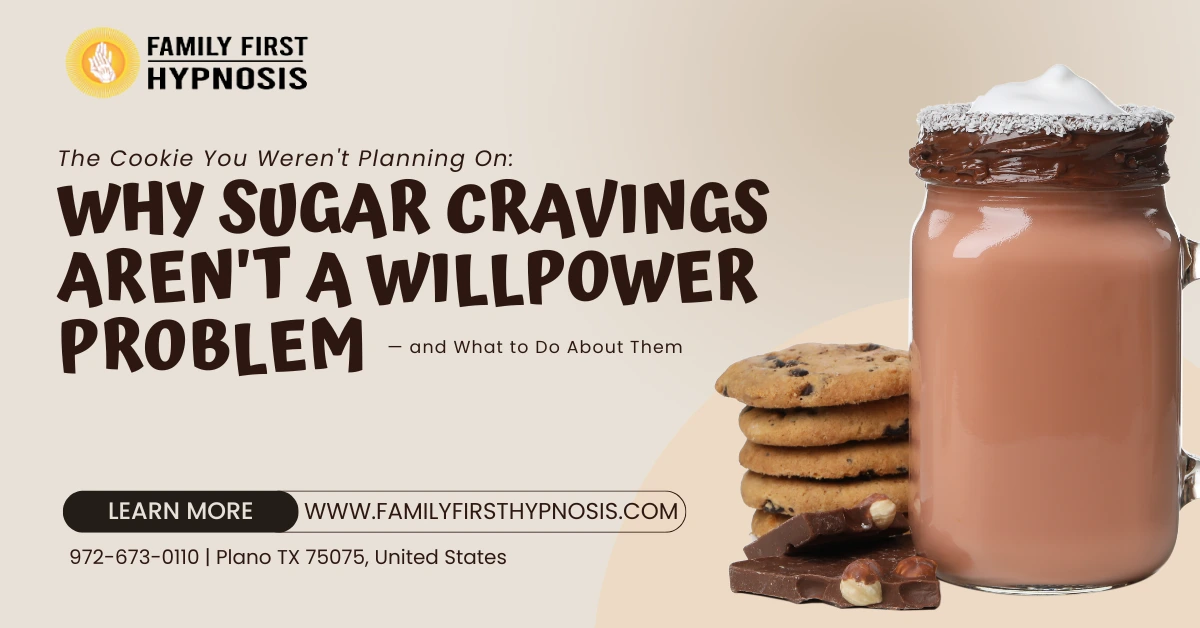
It was 3 in the afternoon. You had a good breakfast. You had a good lunch. You had the water bottle. You had the plan. And then somewhere between the emails and the next meeting, the thought quietly appeared—the cookie in the break room, the piece of chocolate in the drawer, or the drive-through on the way home — and by the time you noticed you were thinking about it, you were already halfway to it.
That is a sugar craving. And it doesn’t matter how many articles you’ve read on discipline, blood sugar, or clean eating — the craving still wins more often than you’d like to admit. This piece is about why.
Sugar Cravings Aren’t a Discipline Problem
The most common story about sugar cravings goes like this: you don’t have enough willpower, or you don’t know enough about nutrition, or you haven’t found the right meal plan yet. All three explanations sound reasonable, and none of them are why the craving keeps winning.
Sugar cravings live at the intersection of biology, behavior, and subconscious patterns. Your body genuinely reacts with a quick, reliable dopamine reward. Your brain learned, somewhere along the way, that sugar was the fastest and cheapest way to shift a mood. And your subconscious — the part that runs the show at 3 PM when your prefrontal cortex is exhausted — has been storing that association as a working rule for years. The rule is: when I feel like this, this specific thing helps.
You cannot out-logic that rule. Your conscious mind agreeing that a cookie won’t fix your Tuesday is not the same mind that reaches for the cookie.
The Specific Signals Most People Miss
Sugar cravings almost never announce themselves as sugar cravings. They show up as a set of ordinary-looking moments that add up to a pattern:
- A very specific time of day — usually mid-afternoon or after dinner — when the craving arrives on schedule
- A very specific food — the same candy, the same drink, the same brand — chosen for a specific feeling, not for taste
- A specific emotion — the low-grade slump, the mild fear after a hard email, the flat feeling between tasks, the wired exhaustion at the end of the day
- A specific self-talk pattern — ‘just this one,’ ‘I earned this,’ ‘I’ll start over tomorrow’ — the same three or four internal sentences on rotation
- A crash after the sugar — the blood-sugar dip, the mood dip, the tired heaviness that sends you looking for the next hit an hour later
- A weekend or vacation amplifier — the pattern gets louder when the structure of the week loosens
The Biological Part Nobody Explains Clearly
Sugar triggers a specific dopamine response in the brain. That is not a moral failing. It’s an ancient piece of wiring. When you eat sugar, especially quickly and especially in a moment of stress or fatigue, your brain gets a fast reward signal that says: this worked, do it again. Over months and years, that signal reinforces itself. Over time, your brain becomes very efficient at anticipating when a sugar reward is available.
On top of the dopamine loop, refined sugar causes a rapid blood-sugar spike followed by a crash. The crash triggers another craving. So most sugar cravings aren’t one craving — they’re a chain of cravings, each one caused by the last.
This is one of the mechanisms behind the keto plateau pattern a lot of people run into: the physical protocol works for a while, and then the underlying craving pattern finds a new way in — usually through a specific ‘allowed’ food that starts filling the same emotional slot the sugar used to.
The Subconscious Part That Matters Most
Under the biology, there is almost always a story. Sugar was the reward after school. Sugar became part of celebrations, family traditions, and moments of comfort. Sugar was the specific thing that always felt like being loved, being safe, being little for a minute. The subconscious kept that link. It has been running it as a comfort-and-safety rule ever since, no matter how many nutrition books have been layered on top.
This is why the craving isn’t really about the food. The specific food is doing a job the food was never designed to do — soothe, reward, punctuate the day, restore a feeling that other things used to restore.
It’s the same layer where bad habits don’t listen to logic and where the diet that never started lives. The conscious mind agreeing with a plan is not the mind reaching for the cookie.
Why ‘Just Have More Willpower’ Doesn’t Work at 3 PM
Willpower is a conscious-mind resource. It’s finite. It depletes as the day goes on. By mid-afternoon, after a full day of decisions, most people have essentially no willpower left — and mid-afternoon is exactly when sugar cravings light up. The craving is scheduled for the moment your willpower is at its lowest, because that’s the moment your subconscious can most reliably run the pattern.
Trying to fix sugar cravings with willpower is like trying to fix a leaky faucet just as the water pressure spikes. You can hold it back for a while. The pressure keeps building because the leak is somewhere else entirely.
This is also why the pattern often intensifies during stressful stretches or burnout that doesn’t lift with a vacation — when the nervous system is running hot, sugar is often the cheapest, fastest self-regulation tool left.
How Hypnosis Actually Makes It Easier to Turn Away From Sugar
Hypnosis works at exactly the layer where the pattern lives. It helps people exercise a natural subconscious ability to access and work with the patterns that have been running automatically for years. Rather than trying to overpower cravings with willpower, hypnosis works with the subconscious associations that quietly linked sugar to comfort, reward, and relief. The work isn’t about relying on more discipline or asking you to fight the craving harder. It isn’t about swearing off sweets. It isn’t about the same speech you’ve already given yourself a hundred times.
It’s about the subconscious learning that the specific moment — the 3 PM slump, the after-dinner drop, the wired late night — doesn’t need sugar anymore. That the feeling the craving was reaching for can be met in ways that don’t have to be eaten. That the loop can just… stop.
Clients typically describe the change as quiet and specific:
- The 3 PM craving stops without effort — or the pull is smaller, and the pull is shorter
- The specific food loses its emotional weight — the cookie becomes just a cookie
- The cycle of repeated cravings also loosens — one small sweet no longer triggers a whole afternoon
- The self-talk changes — the ‘just this one’ loop just stops running as often
- The weekend and vacation amplifier gets softer — the structure of the week matters less
Where This Fits Into the Bigger Picture
If sugar cravings are the main reason weight loss hasn’t stuck for you, our Weight Loss program is designed for exactly this layer. If it feels less like weight loss and more like a self-control question overall, Self-Control work and Hypnosis for Bad Habits both meet the same pattern from different angles. And if the driver underneath is chronic stress, our Fear & Hopelessness program and our Stress program address the layer that the sugar has been trying to soothe.
For a fuller picture of how hypnosis actually works, here’s the complete guide. And if getting to an in-person session isn’t realistic right now, all of this work is available online, one-on-one over Zoom, from wherever you are.
The 3 PM Cookie Doesn’t Have to Be Your Life
Sugar cravings are one of the quietest, most repeatable patterns a person can carry. Nobody around you sees the specific slump or the specific food or the specific chain of cravings that follows the first bite. From the outside, it looks like a small thing. From the inside, it’s a loop that’s been running for years.
The loop is loosenable. The specific food can stop meaning what it currently means. The 3 PM craving can shrink to a passing thought. And the version of you who trusts herself around sugar again — she’s still in there. She’s just been overridden by an old rule that doesn’t know its moment is over.
If any of this piece described your last few years of afternoons, hypnosis is a real option. At Family First Hypnosis, Celeste Hackett has spent more than two decades helping clients across Plano, Frisco, McKinney, Allen, Richardson, Carrollton, Garland, and the wider North Texas area work with the patterns underneath sugar cravings, emotional eating, and weight loss.