



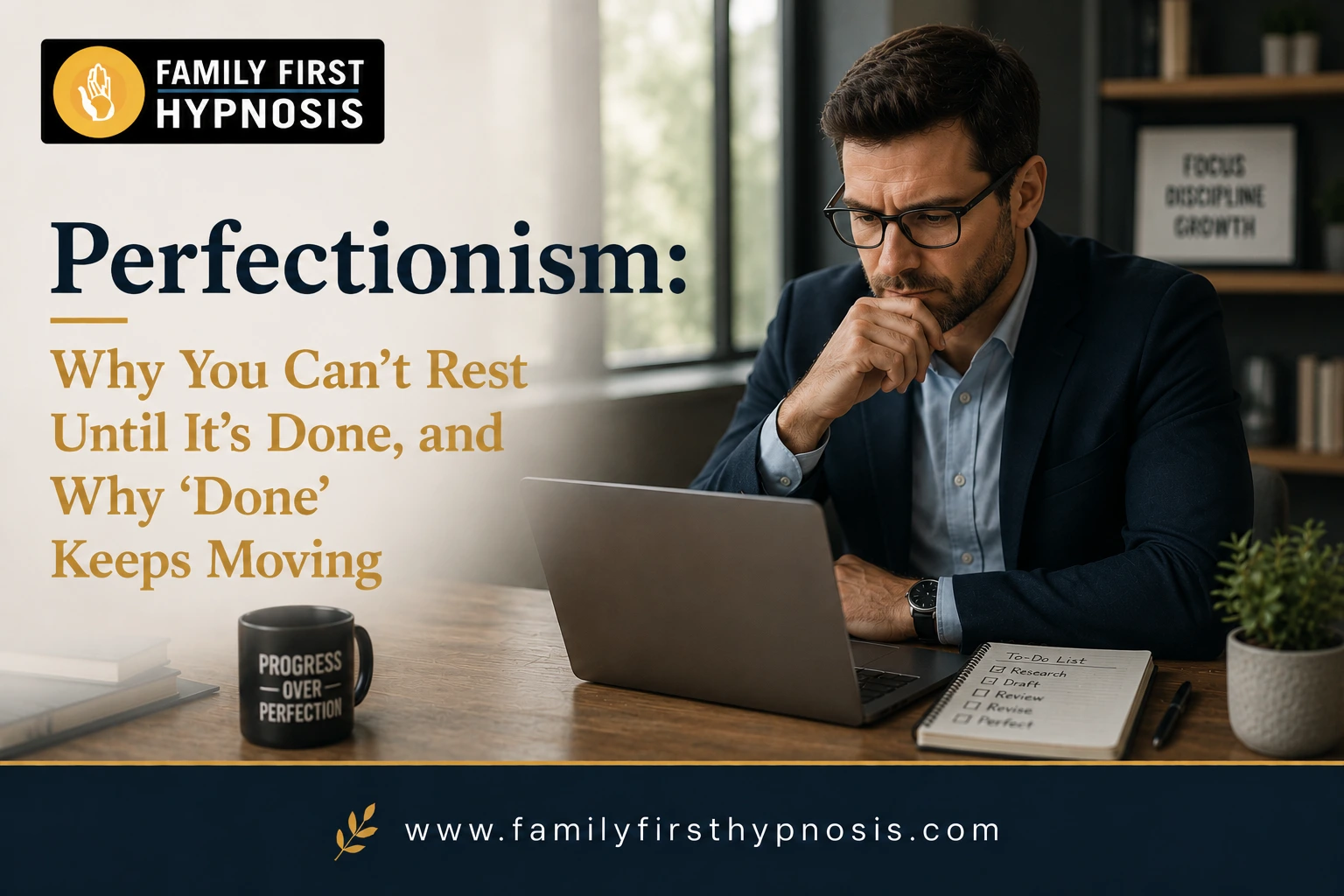
You finish the task. It’s fine. It’s actually more than fine. Anyone else looking at it would call it done. You reread it one more time. You find the sentence that isn’t quite right. You fix it. You reread the whole thing again to make sure the fix didn’t break something else. Now the introduction feels weak. You rewrite the introduction. It’s an hour later. You still can’t send it.
That is perfectionism. It looks like high standards. It feels like caring. It works — mostly. And it is quietly costing you something specific.
Perfectionism Isn’t a Personality Trait
Most articles on perfectionism will tell you it’s a personality style, or a strength that has a shadow, or a cognitive distortion. All of that is descriptively true and none of it explains why perfectionism is so resistant to change. You can name the pattern. You can even see the pattern in the moment. You still cannot stop.
Perfectionism isn’t a personality trait. Somewhere along the way, your system quietly linked being flawless to being safe, or being loved, or being allowed to exist without criticism. The link got hardwired. It made complete sense at the time because, from your subconscious perspective, it felt true. And the subconscious does not update loyalties easily, no matter how many times the conscious mind agrees it’s ready to.
The Signals Most People Miss
Perfectionism rarely announces itself as perfectionism. It shows up as something more specific:
- Not being able to stop working on something long after it’s technically done
- The one detail that ruins the whole thing — a photo, a party, a project, a meeting — where everyone else saw it as a success and you saw the one thing that wasn’t right
- A specific internal voice that critiques your work in real time, usually in the same tone throughout the day
- Procrastination on the exact projects you care most about — because starting means potentially producing something that isn’t perfect
- A version of rest that doesn’t actually rest — you sit down, you feel guilty, the internal list starts up again
- A quiet inability to receive compliments — you always know the part they missed
- A specific physical baseline — a low-grade tension in the shoulders and jaw that never fully leaves
Why ‘Just Get it Done” Doesn’t Help
You’ve read the article. You’ve heard the podcast. You’ve maybe even said it out loud, on purpose, in front of a mirror. And in the exact moment it matters — the send button, the presentation, the meal for the guests, the return-to-work project — the voice starts up again, and knowing about the pattern doesn’t stop the pattern.
That’s because knowing lives in the conscious mind. The pattern lives underneath it. Trying to fix perfectionism with a slogan is like trying to fix a stuck valve by describing water. The valve keeps doing what it was set up to do.
This is the same layer where overthinking that can’t be outsmarted and impostor syndrome that doesn’t respond to résumés both live. Perfectionism is usually running alongside both — they tend to travel together.
Where the Pattern Actually Comes From
For most people, perfectionism traces back to something quiet and formative. A parent whose approval had a specific shape. A teacher whose praise came with a condition. A family where the reward for being excellent was more expectation, and the cost of not being excellent was something that felt worse than tiredness.
The pattern usually installed itself as a reasonable strategy at the time. If being flawless meant being loved, being safe, being praised, being kept — the strategy was doing its job. The subconscious does not know that the moment has changed. It’s still running, the subconscious rule that flawlessness equals safety , decades later, on projects and dinners and emails that don’t require any of it.
What ends up costing you isn’t the standard. It’s the loyalty. Somewhere underneath, a part of you is being loyal to an old rule. And every time you almost stop reworking the sentence — and then don’t — that loyalty is why.
The Quiet Cost Most People Don’t Count
On the surface, perfectionism looks like it’s making everything better. Underneath, it’s charging a specific tax:
- Time — the extra hours on things that were already ready an hour ago
- Rest — the days off that don’t count as days off because the internal audit never stops
- Bandwidth — the projects you don’t start because you already know how much energy the finish will demand
- Joy — the moments that got past you because you were noticing the one thing that wasn’t right
- Relationships — the version of you the people around you love has been quietly running behind the version who is always about to finish something
It’s also one of the quiet engines behind burnout. Burnout that doesn’t lift with a vacation almost always has a perfectionism pattern underneath it — the reason the vacation doesn’t lift the burnout is that the internal audit came on the trip.
How Hypnosis Actually Softens It
Hypnosis works at the layer where these subconscious patterns live. Rather than trying to force yourself to think differently, hypnosis helps you access the subconscious information behind the old rule that linked being perfect with being safe, accepted, or worthy.
The goal isn’t to lower your standards or stop caring about your work. It’s to help the subconscious recognize that the old rule is no longer necessary. As that pattern begins to change, many people notice that sending the email becomes easier, the extra hour of editing is no longer automatic, and rest finally feels like rest instead of another opportunity to mentally review everything that still needs fixing.
Clients often describe a quieter relationship with their own work. They still care deeply—but they’re no longer driven by the constant fear that anything less than perfect isn’t enough.
This is also often the layer underneath the pattern that stops you right before the finish line — because a perfectionism pattern is what quietly convinces you the finish line isn’t ready yet, and won’t be, and can’t be, and shouldn’t be crossed until it is.
Where This Fits Into the Bigger Picture
Perfectionism rarely lives alone. It’s usually tangled up with fear, over-preparation, and a nervous system that never fully rests. Our Fear & Hopelessness program and our Stress program both meet the piece that’s constantly bracing. Success Block hypnosis addresses the version of the pattern that stops you right before the visible next step. And Self-Control work often eases the quiet self-soothing behaviors — the doom-scrolling, the late-night snacking, the second glass — that tend to appear when the inner critic never gets a day off.
For a fuller picture of how hypnosis works and what a series of sessions actually looks like, learn more about what actually happens during a hypnosis session. And if getting to an in-person session isn’t realistic right now, all of this work is available online, one-on-one over Zoom, from wherever you are.
You Are Not the Pattern. You Are the Person Underneath It.
Perfectionism is one of the most quietly draining patterns a person can carry, in part because from the outside, it looks like an asset. The people around you don’t see the extra hour, the internal audit, the send button, the rest that isn’t rest,.
The pattern can change. The rule can be updated. The constant inner critic can finally quiet. The version of you who can put something down when it’s done — who can rest, receive, cross the finish line, and mean it — has been in there all along. She has just been overridden by an old loyalty that doesn’t know its moment is over.
If any of this piece describes your last decade, hypnosis is a real option. At Family First Hypnosis, Celeste Hackett has spent more than two decades helping high-functioning clients across Plano, Frisco, McKinney, Allen, Richardson, Carrollton, Garland, and the wider North Texas area work with the patterns underneath perfectionism, fear, and over-preparation—and virtually with clients from anywhere.
The simplest place to start is a free 30-minute Discovery Call with Celeste. It’s an opportunity to talk about what you’ve been experiencing, ask questions about the process, and explore whether hypnosis may be the right next step for your goals.