



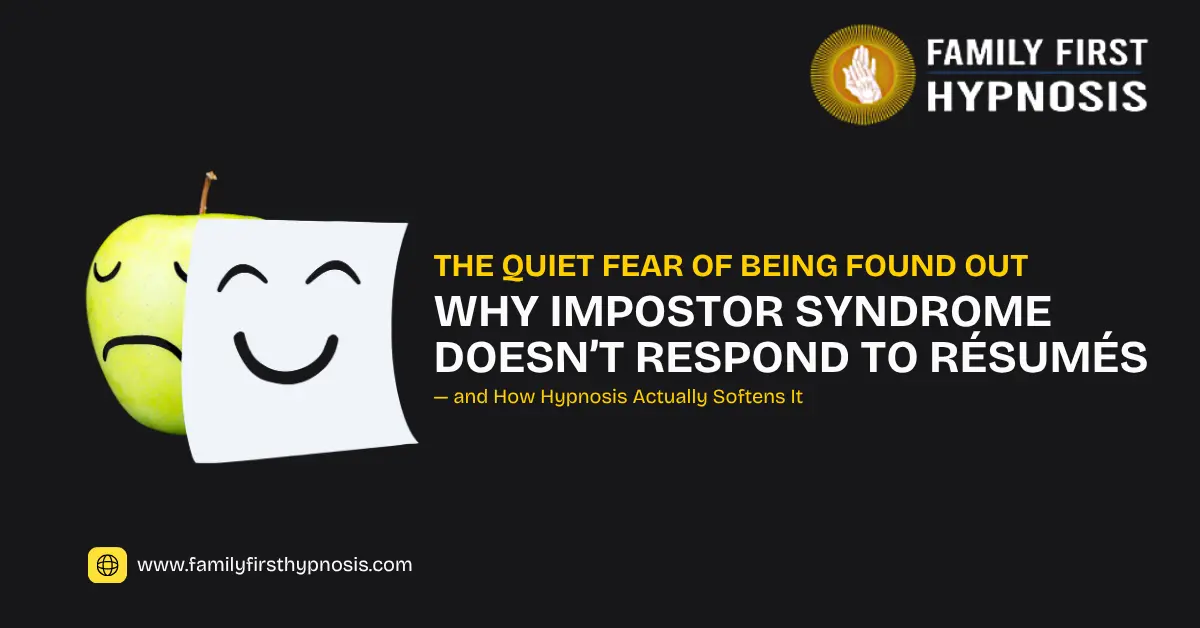
You’ve done the work. The degrees, the certifications, the promotions, the reviews, the years of quietly outperforming what most people around you can pull off. And you still walk into the meeting bracing for the moment someone finally figures out you don’t actually belong there.
Nothing about your résumé is missing. Your track record is a wall of quiet evidence you can’t seem to look at directly. And still — the fear. The scan of the room. The over-preparation. The tightness before the presentation. The strange relief when a compliment lands, followed almost immediately by the internal correction: they don’t know the full picture.
That’s impostor syndrome. And no matter how many times you’ve tried to logic your way out of it, it hasn’t moved. This piece is about why — and about what actually shifts it.
Impostor Syndrome Isn’t a Résumé Problem
This is the piece almost every article on impostor syndrome misses. You cannot fix impostor syndrome by adding one more line to your résumé. You cannot fix it by winning one more award, closing one more deal, or getting one more “you’re amazing” message from your boss. If external achievement fixed impostor syndrome, high-achievers would be the most self-assured people in every room. They are frequently the least.
Impostor syndrome doesn’t live in the achievement layer. It lives underneath. It’s a subconscious pattern — a quiet, deeply held belief that got installed long before you ever had a professional identity, and it has been running in the background of your accomplishments ever since. The achievements pile up. The belief doesn’t update. That’s the whole trick.
Where the Pattern Actually Comes From
For most people, impostor syndrome traces back to something small and formative. A parent who was loving but hard to impress. A childhood where being praised for being smart, gifted, or advanced accidentally became conditional on staying that way. A moment of being singled out in class and quietly deciding never to be exposed again. A family system where love and achievement got braided together so tightly that the two became indistinguishable.
The pattern isn’t about what happened, exactly. It’s about the conclusion the subconscious drew at the time — a conclusion that made total sense back then and has been silently running the show ever since. Something like: if I ever stop performing at this level, the ground will fall out from under me. Or: if they really knew me, they wouldn’t be this impressed. Or: my worth is only as real as my last success.
This is the same layer where overthinking that can’t be outsmarted lives, and it’s the same reason burnout doesn’t lift with a vacation. You’re not underperforming. You’re running on a subconscious rule that says the moment you stop performing, everything collapses.
What Impostor Syndrome Actually Costs You
On the surface, impostor syndrome looks like humility, hard work, and high standards. Underneath, it’s costing you something specific:
- Over-preparation — hours of extra time on things that were already ready an hour ago
- Quiet self-editing — softening your ideas in the meeting so no one accuses you of overreach
- A ceiling on the bigger asks — the promotion, the raise, the bigger room, the visible role — that a part of you quietly declines to reach for
- A permanent inner critic — a voice narrating everything you do, always somewhere between “not quite right” and “about to be found out”
- Exhaustion that no one around you can see — because from the outside, you’re winning
The last one is especially quiet: impostor syndrome is often the invisible engine behind the pattern that stops you right before the finish line — the trip you don’t take, the interview you don’t schedule, the visible next step you keep almost taking. It looks like caution. It’s a belief that says the ceiling can’t be raised without something being taken away.
Why “Just Own Your Accomplishments” Hasn’t Worked
Advice around impostor syndrome usually falls into two buckets: think differently about it, or fake it until you make it. Both leave the underlying pattern completely untouched, which is why they don’t work for long.
Thinking your way out of impostor syndrome is like trying to talk yourself out of being cold. You can decide the room shouldn’t feel cold. Your body still feels cold. The subconscious runs the temperature. The subconscious runs impostor syndrome. The conscious mind is downstream of both.
Faking it doesn’t work either, because the subconscious knows exactly what it believes about you, and the gap between the belief and the performance is precisely what impostor syndrome feeds on.
How Hypnosis Actually Softens It
Hypnosis works where the pattern actually lives. In a deeply relaxed, focused state, the subconscious becomes remarkably open to updating old, outdated rules — the same way an operating system updates in the background while everything else keeps running. The old file that said your worth was conditional on performance gets loosened. The old file that said being seen fully would be dangerous gets softened. The old file that said the ground would fall out from under you if you stopped performing gets rewritten.
You don’t stop caring about your work. You stop bracing against your own success. There is a very specific quality to the change: the accomplishments start feeling like they belong to you. The room stops feeling like it’s about to figure you out. The internal narrator quiets. The over-preparation gets shorter. The bigger asks feel askable.
Clients who work with this pattern in hypnosis often describe what shifts as a kind of quiet coming-home to their actual competence. This is also the layer where real personality change actually happens — not a new personality, but a return to the one that had been getting quietly overridden by the impostor pattern.
Where Impostor Syndrome Overlaps With Other Patterns
Impostor syndrome rarely lives alone. It’s usually tangled up with fear, perfectionism, and a quiet inability to rest. Our Fear & Hopelessness program and our Stress program both meet the piece that’s constantly bracing for exposure. Success Block hypnosis addresses the version of the pattern that quietly stops you right before the visible next step. And Self-Control work often eases the quiet coping behaviors — late-night snacking, doom-scrolling, the second drink — that tend to appear when the inner critic never gets a day off.
If getting to an in-person session isn’t realistic right now, all of this work is available online, one-on-one over Zoom, from wherever you are.
You Are Not Faking It. You Just Have an Old File Running.
Impostor syndrome is one of the loneliest patterns to carry, because nobody around you is going to argue with it. From the outside, you look like a person who has it together. From the inside, you’re managing an invisible weather system that never quite clears.
The good news is: this pattern is loosenable. The old rule can update. The evidence you already have of your own capability can finally start landing where it should have all along. You don’t need to become a different person. You need the version of you that already exists — competent, thoughtful, deserving — to stop being overridden by an old subconscious file.
If any of this piece described your last decade, hypnosis is a real option. At Family First Hypnosis, Celeste Hackett has spent more than two decades working with high-functioning clients across Plano, Frisco, McKinney, Allen, Richardson, Carrollton, and the wider North Texas area — and now, virtually, from anywhere. The simplest place to start is a free 30-minute Discovery Call with Celeste. It’s a low-pressure conversation, and it’s usually the first quiet step back to a version of yourself who gets to be as good as you actually are — without bracing for someone to notice.