



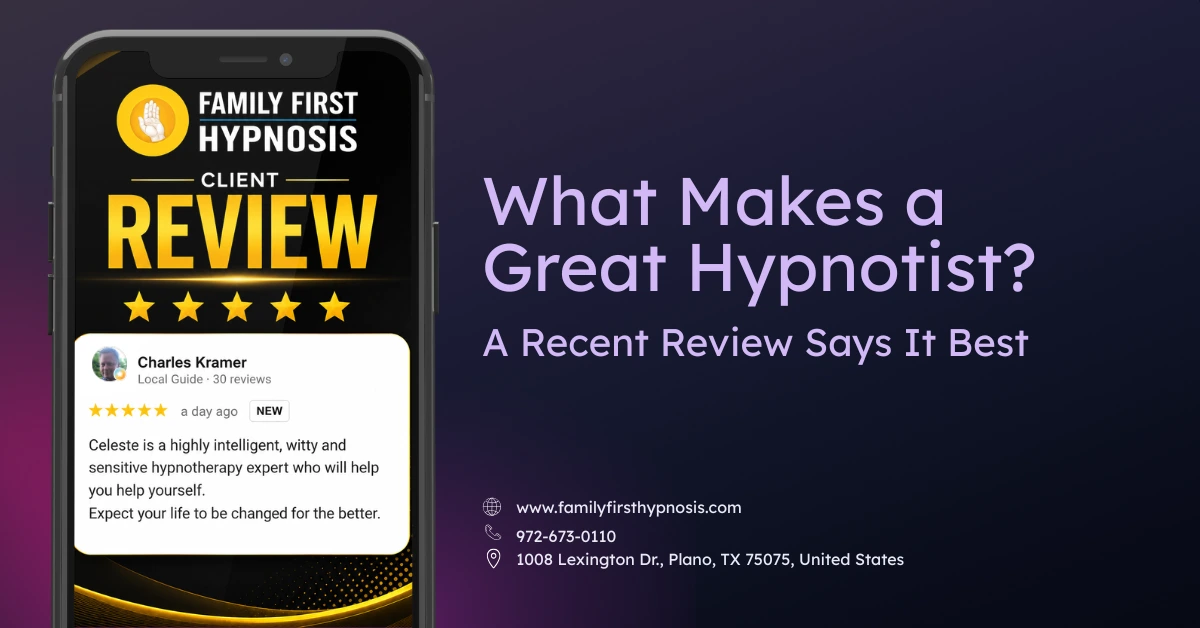
Every so often, a client puts into words something we’d struggle to say about ourselves. A recent Google review from Charles Kramer did exactly that:

It’s a short review, but it’s worth sitting with, because it names three qualities that matter far more in hypnosis work than most people realize — and one phrase in particular that gets right to the heart of how this work is supposed to feel.
Reviews like this one are useful for reasons beyond flattery. Anyone can write marketing copy describing an ideal hypnosis session. It’s much harder to describe, in plain language, what it actually felt like to experience it. Charles wasn’t trying to explain hypnosis or promote the practice. He was simply describing what stood out to him. That’s exactly why his words are worth exploring.
“Highly Intelligent”
Hypnosis isn’t a script that’s read the same way for every client.
People may arrive with similar concerns—a fear, a habit, difficulty sleeping, or feeling stuck—but the subconscious patterns behind those experiences are rarely identical. Two people may both struggle with a fear of flying, yet for one person the issue may relate to control, while for another it may connect to an earlier experience of feeling trapped or unsafe.
A skilled hypnotist listens carefully, notices those differences, and adjusts the approach to fit the individual rather than forcing everyone through the same process.
That’s often what clients mean when they describe a hypnotist as intelligent. It’s less about displaying knowledge and more about understanding people well enough to know where the real work needs to begin.
“Witty”
People don’t always expect humor to be part of hypnosis.
Many assume the work will be heavy or intensely serious. Yet genuine warmth and appropriate humor often help people settle into the conversation more naturally.
When someone feels comfortable, they’re more willing to explore what’s been keeping them stuck. That doesn’t mean avoiding difficult topics. It simply means creating an environment where people don’t feel judged or pressured.
Sometimes a well-timed smile or lighthearted moment makes it easier for someone to engage with work that otherwise might feel overwhelming.
“Sensitive”
Sensitivity is what allows everything else to work.
Before people can explore long-standing subconscious patterns, they need to feel heard, respected, and understood. That trust can’t be rushed.
A sensitive hypnotist pays attention not only to what’s being said, but also to what isn’t. Sometimes that means recognizing when someone needs more time. Other times it means noticing that they’re ready to explore something they weren’t prepared for a few sessions earlier.
Rather than pushing clients toward a predetermined outcome, the work unfolds at the pace that’s right for the individual.
That quiet attentiveness often goes unnoticed in the moment, which may be why Charles chose to mention it specifically.
Why All Three Matter Together
Any one of these qualities on its own has a limit. Intelligence without sensitivity can feel clinical and impersonal. Sensitivity without intelligence can feel warm but aimless, without much direction toward actual change. Wit without either can feel flippant, like the real work never gets serious enough to matter. It’s the combination — reading a person accurately, adjusting the approach with real skill, and doing it all without ever losing warmth — that tends to produce the kind of session Charles is describing.
“Help You Help Yourself”
This might be the most important phrase in the whole review, because it’s exactly how hypnosis is supposed to work. Hypnosis isn’t something done to a client — it’s a natural ability everyone already has, simply exercised with intention and guidance. The role of a good hypnotist isn’t to take control; it’s to help a client access something that was theirs all along.
Charles didn’t need to know the technical language for that to come through in his own words. He felt it — the sense that the change happening in the room was something he was doing, with support, rather than something being done to him. That distinction matters more than it might seem. It’s the difference between leaving a session dependent on someone else and leaving with a clearer sense of your own subconscious patterns and how to work with them going forward.
About That Final Line
Charles ends his review by saying,
“Expect your life to be changed for the better.”
That’s a powerful statement, and it’s important to recognize it as his personal experience.
Every client is different. Each person brings a unique history, different goals, and their own timeline for change. No ethical hypnotist can promise identical results for everyone.
What reviews like this do offer is a genuine glimpse into one person’s experience. They remind us that meaningful change is possible, and that sometimes the most compelling description of hypnosis comes from someone who has experienced it firsthand.
Curious Whether Hypnosis Is Right for You?
If you’ve been wondering whether hypnosis could help you move beyond a habit, fear, or pattern that’s been difficult to change, a conversation is often the best place to begin.
Schedule a complimentary 30-minute Discovery Call with Celeste Hackett to ask questions, learn more about the process, and explore whether this approach aligns with what you’re looking for.
Family First Hypnosis works with clients throughout Plano, Frisco, McKinney, Allen, Richardson, Carrollton, The Colony, Garland, Dallas, and virtually anywhere through one-on-one virtual sessions.