


You booked the ticket. Maybe it was even your idea—a trip you’re genuinely looking forward to, a reason worth the travel. And somewhere between booking it and the departure date, a low hum of dread moved in and set up camp. You check the flight status more than you need to. You picture turbulence during ordinary moments, like loading the dishwasher. The trip you wanted is still the trip you want—you just have to get through the flight first.
Here’s what surprises a lot of people about this fear: it doesn’t always show up early in life, and it doesn’t always come from one dramatic incident. Plenty of people fly for years without a second thought, then notice, gradually, that they’ve become more sensitized to it—more aware of every sound the plane makes, more braced for turbulence that used to barely register.
One client put it simply: she’d never been afraid of flying in her life. Then, sometime during the past year, she found herself fearing it anyway—even while booking a trip she was excited about to meet a new baby in the family.
It’s Not About the Statistics
Most people with a fear of flying already know that flying is statistically one of the safest ways to travel. That knowledge rarely helps.
Fear of flying isn’t a math problem, and it doesn’t respond to being told the odds because the fear isn’t being generated by the part of your mind that weighs statistics. It’s a subconscious response, and subconscious responses don’t stop to check the numbers before reacting.
What tends to drive the fear instead is a mix of things that have very little to do with actual risk: the lack of control, the inability to simply step outside if something feels wrong, the unfamiliar sounds and sensations of turbulence, or sometimes no clear reason at all—just a sense of unease that gradually built over time, the way it did for the client above.
Why Willpower Runs Out Around 30,000 Feet
You can talk yourself through a lot of things with willpower. Fear of flying tends to wear willpower down quickly because it’s not a single moment you’re gritting your teeth through—it’s hours, sometimes with turbulence arriving just as you’d finally started to relax.
Bracing that hard for that long is exhausting, and exhaustion tends to make the fear feel bigger by the end of the flight, not smaller.
This is where hypnosis works differently.
Rather than giving you another technique to rely on during takeoff, hypnosis works with the subconscious pattern producing the fear response in the first place by exercising your natural ability to enter hypnosis and access the subconscious patterns connected to that fear.
Sometimes a specific memory is connected to when the fear began. Other times, as with gradual sensitization like the client described above, there isn’t one clear starting point—just a pattern that developed over time.
Either way, the goal isn’t to prove exactly why the fear started. It’s to understand and resolve the emotional pattern that’s keeping it active today.
What Change Often Looks Like
There’s no guaranteed outcome or set timeline, and every client’s experience is different.
Many clients describe the first change as feeling less consumed by the anticipation. The weeks leading up to a trip become calmer. Turbulence no longer triggers the same full-body reaction. Flying begins to feel like something they can simply do rather than something they have to survive.
For some people, flying becomes routine again. For others, it simply stops being the thing standing between them and the experiences they want to have.
A Real Client’s Experience
Every person’s story is different, but many people are surprised by how quickly their relationship with flying can begin to change once the subconscious pattern behind the fear is addressed.
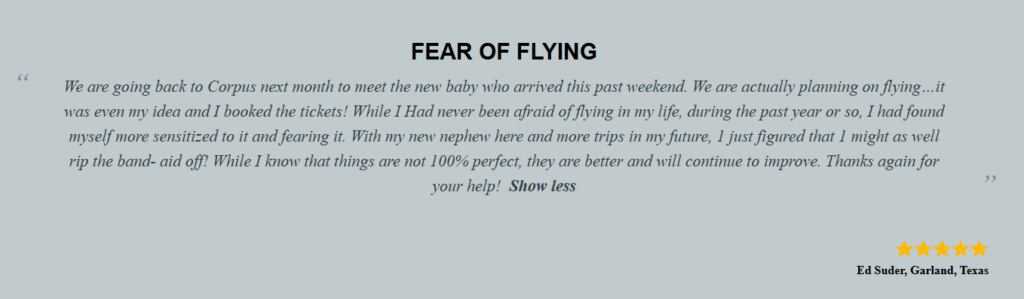
One client, who had never been afraid of flying until it gradually developed over the course of a year, shared this after her sessions:
Frequently Asked Questions
No. Some clients trace it to a specific flight or experience. Others, like the client mentioned above, notice it developed gradually with no obvious starting point. Both situations can be appropriate for hypnosis.
No. The work happens during a hypnosis session—not on an airplane. Many clients notice the difference the next time they fly.
Statistics appeal to the logical, conscious mind.
Hypnosis works with the subconscious patterns that automatically produce the fear response, which is why it can help when logic alone hasn’t created lasting change.
Yes. Some people seek hypnosis after avoiding air travel for months or even years. The length of time you’ve experienced the fear doesn’t necessarily determine how the subconscious responds to change.
Ready to Feel Steady in the Air Again?
Even if you’re flying out of DFW, Dallas Love Field, or anywhere else, you don’t have to keep dreading the trips you genuinely want to take.
Family First Hypnosis works with clients throughout Plano, Frisco, McKinney, Allen, Richardson, Carrollton, The Colony, Garland, Dallas, and virtually anywhere.
If you’re wondering whether hypnosis may be the right fit for your situation, schedule a free 30-minute Discovery Call with Celeste Hackett.
It’s an opportunity to ask questions, learn more about the process, and decide whether this approach feels like the right fit for you.