

The Complete Guide to Hypnosis: What It Is, How It Works, and Everything It Can Help You Change
The plain-English, no-mysticism, comprehensive guide for everyone who has ever wondered if hypnosis could finally help them shift something that hasn’t budged.

If you have ever quietly wondered whether hypnosis could finally help you change something you have tried — and failed — to change on your own, this guide is for you.
Not the stage-show version. Not the swinging-watch movie scene. The real thing. The kind of hypnosis that has helped tens of thousands of ordinary people stop smoking, lose weight, sleep through the night, repair relationships, quiet anxious thoughts, recover from grief, perform under pressure, and feel like themselves again.
This is the comprehensive guide. We will cover what hypnosis actually is, how it actually works, every major area it can help with, what a real session looks like, and the most common questions people ask before they call. Wherever you want to go deeper on a specific topic, you will find a linked article that takes you there.
Family First Hypnosis is led by Celeste Hackett, a Board-Certified Consulting Hypnotist based in Plano, Texas, with more than two decades of experience helping clients across Plano, Frisco, McKinney, Allen, Richardson, Carrollton, and (virtually) anywhere.

If anything here resonates, you can read more about her on the About page, or skip ahead to schedule a free 30-minute Discovery Call.
What Hypnosis Actually Is — And What It Isn’t
First, what it is not
Hypnosis is not mind control. Nobody can make you do something against your values. You do not lose consciousness. You do not get stuck. You do not reveal secrets you did not intend to share. You do not hand the steering wheel of your life to anyone else, even for a minute. None of the stage-show and movie tropes describe what is happening in a real clinical hypnosis session.
If you are genuinely skeptical of hypnosis as a category, this honest first-person account from a former skeptic is worth a read: Is Hypnosis a Real Thing? A Skeptic’s Honest Experience. And if you are wondering whether hypnosis works on everyone, this guide explains the science behind hypnotic responsiveness.
What hypnosis actually is
Hypnosis is your natural ability to access the subconscious mind, uncover information or patterns that may be negatively affecting you, and change them so you can create the changes you want in your life.
You stay aware. You hear everything. You stay in control. You can stop, ask questions, or simply choose not to engage with any suggestion.
If you have ever been so absorbed in a book that you lost track of time, driven a familiar route without remembering the last few miles, or felt yourself drift while doing something you love, you have already experienced something very close to the hypnotic state. The doorway is not strange. It is something your mind moves through almost every day.
What is different in a hypnosis session is that this natural ability is used intentionally to access the subconscious and work with the patterns running underneath the surface of your life.
How Hypnosis Actually Works
The two minds you are running on
Most of what runs your life does not happen at the level of your conscious mind. The conscious mind sets the goals. It says, “I want to lose weight.” “I want to stop smoking.” “I want to stop snapping at my partner.” “I want to sleep through the night.”
Then the subconscious mind — the part of you that runs habits, emotional reactions, attachments, sleep, hunger, performance, and almost every automatic behavior — quietly continues to do what it has always done. That is why willpower so often fails. The conscious mind agrees with the goal. The subconscious mind is still on the old script.
This is exactly the reason bad habits don’t respond to logic, smoking isn’t really about willpower, weight loss has less to do with discipline than people think, and overthinking can’t be outsmarted. The level you are trying to fight the pattern on isn’t the level the pattern lives on.
Where hypnosis comes in
Hypnosis moves the work to the right layer—the subconscious mind. It gives you an opportunity to uncover and work with patterns that may have been quietly running for years. Instead of fighting yourself from the outside, you can begin addressing the underlying pattern and create the changes you want in your life..
The deeper the root, the more useful this becomes. Many of the patterns people struggle with are formed long before adulthood. Age regression hypnosis is one of the most powerful tools for getting to the actual root cause and resolving it — instead of managing it forever.
And if you’re wondering why hypnosis can create change at all when so many other things haven’t worked, this piece explains the underlying shift: Is Your Self-Belief Outdated? What the Second Scientific Revolution Teaches Us About Change.
Everything Hypnosis Can Help You Change
This is the heart of the guide. Below is the most comprehensive picture of what hypnosis is actually used for — and what real clients use it to change. Each area links out to a deeper piece on that specific topic.
Stop Smoking
Most people who smoke have tried to stop multiple times — patches, gum, vaping, cold turkey, willpower — and watched themselves return to it. That isn’t a strength problem. It is a pattern problem. The cigarette is doing a quiet job for the subconscious: regulating stress, marking transitions, filling space, providing identity. Until those subconscious associations are addressed, quitting feels like fighting yourself.
Hypnosis works at exactly that level. Learn more about our Stop Smoking program or read how the subconscious side of smoking actually works.
Weight Loss & Emotional Eating
Weight loss almost never breaks down at the level of information. People know what to eat. The breakdown happens at the level of the inner pattern — the late-night kitchen visits, the stress eating, the way certain emotions quietly steer the fork. The diet that never started explains why willpower keeps losing this battle. The sweet tooth and the heavy heart explores the emotional side. And if you find yourself waking up hungry at night, that’s rarely about food at all.
Learn more about our Weight Loss program.
Anxiety, Overthinking & Stress
Anxiety lives in the body, not in logic. That is why “just stop worrying” doesn’t work. The mind that won’t turn off explains why overthinking can’t be outsmarted from the surface. The sky isn’t falling offers a calmer relationship with the inner alarm system. How to handle negative emotions instead of distracting from them addresses the bigger pattern underneath. And in a stressed world, how political news and algorithms quietly keep us on edge is worth understanding.
Real stories of clients walking out the other side: Blake’s story of real-world anxiety resolution, and from anxiety and sleepless nights to peace. For pre-procedure nerves specifically, Katie’s pre-surgery to ICU calm story is remarkable.
Learn more about our Anxiety & Depression program or Stress program.
Depression & Difficult Seasons
Depression isn’t something to muscle through. This piece on how negative thought patterns actually develop explains what hypnosis can address at the subconscious level. And if you’re in one of those seasons that feels heavier than the others, the hardest chapter was written for you.
Sleep & Insomnia
If lying down has slowly turned into something you brace for, you are not broken. Sleep is a state, not a decision — and the nervous system has to feel safe enough to release into it. Can hypnosis help insomnia? explores why the active night mind happens. Why you still can’t fall asleep — beyond sleep hygiene explains why hot rooms and lavender alone don’t reach it. And hypnosis for sleep: the organic sleep solution walks through how the work actually unfolds.
Relationships & Relationship Trauma
Relationships are where many people first feel a pattern looping — the same fight, the same brace, the same explanation, over and over. Keeping the lesson without keeping the pain walks through how hypnosis helps you heal what a toxic relationship quietly left behind.
Learn more about our Hypnosis for Relationships program.
Bad Habits, Drinking & Patterns You Want to Break
Phone-checking, nail biting, skin picking, late-night kitchen visits, opening the same app for the eleventh time, scrolling without realizing — every quiet habit is the subconscious doing a job. Why bad habits don’t listen to logic explains the underlying loop. For drinking specifically, how hypnosis changes the pattern beneath the habit is the right starting point.
Learn more about our Hypnosis for Bad Habits program.
Sports Performance
Every serious athlete eventually realizes that the gap between practice and game day isn’t physical. It is the quiet, untrained part of the mind — labels, body memories, expectations, fears — that quietly steers performance under pressure. The quiet part of athletic performance that nobody trains goes deep on this.
Learn more about our Sports Performance program.
Anger
Anger management teaches you to suppress what isn’t actually going anywhere. Hypnosis for anger — why resolution beats management explains a fundamentally different approach: dissolve the underlying pattern instead of containing it forever.
Learn more about our Anger & Rage program.
Grief & Loss
Grief doesn’t move on a timeline. It moves on your nervous system. Grief doesn’t have a timeline — how hypnosis helps you carry what was lost is a gentle place to start if loss has been heavier than the calendar suggests.
Learn more about our Grief program.
Success Blocks
Some patterns only show up right before the finish line — the project you almost ship, the promotion you almost go for, the relationship you almost commit to. The pattern that stops you right before the finish line explores how subconscious success blocks form and how hypnosis loosens them. Michelle’s journey to professional confidence is a real-world example.
Learn more about our Success Block program.
Fears & Phobias
Fear of flying, public speaking, driving, social situations, dental work, medical procedures, water, heights, elevators — fear is one of the most consistently responsive things hypnosis works with, because fears almost always live at the subconscious level. Learn more about our Fear program.
Worry & Sadness
Sometimes what you are carrying isn’t exactly anxiety, isn’t exactly depression, but is a chronic, low-grade weight — a constant background hum of worry or sadness that quietly steers your week. Learn more about our Worry & Sadness program.
Everything Hypnosis Can Help You Change
This is the heart of the guide. Below is the most comprehensive picture of what hypnosis is actually used for — and what real clients use it to change. Each area links out to a deeper piece on that specific topic.

Stop Smoking
Most people who smoke have tried to stop multiple times — patches, gum, vaping, cold turkey, willpower — and watched themselves return to it. That isn’t a strength problem. It is a pattern problem. The cigarette is doing a quiet job for the subconscious: regulating stress, marking transitions, filling space, providing identity. Until those subconscious associations are addressed, quitting feels like fighting yourself.
Hypnosis works at exactly that level. Learn more about our Stop Smoking program or read how the subconscious side of smoking actually works.

Weight Loss & Emotional Eating
Weight loss almost never breaks down at the level of information. People know what to eat. The breakdown happens at the level of the inner pattern — the late-night kitchen visits, the stress eating, the way certain emotions quietly steer the fork. The diet that never started explains why willpower keeps losing this battle. The sweet tooth and the heavy heart explores the emotional side. And if you find yourself waking up hungry at night, that’s rarely about food at all.
Learn more about our Weight Loss program.

Anxiety, Overthinking & Stress
Anxiety lives in the body, not in logic. That is why “just stop worrying” doesn’t work. The mind that won’t turn off explains why overthinking can’t be outsmarted from the surface. The sky isn’t falling offers a calmer relationship with the inner alarm system. How to handle negative emotions instead of distracting from them addresses the bigger pattern underneath. And in a stressed world, how political news and algorithms quietly keep us on edge is worth understanding.
Real stories of clients walking out the other side: Blake’s story of real-world anxiety resolution, and from anxiety and sleepless nights to peace. For pre-procedure nerves specifically, Katie’s pre-surgery to ICU calm story is remarkable.
Learn more about our Anxiety & Depression program or Stress program.

Depression & Difficult Seasons
Depression isn’t something to muscle through. This piece on how negative thought patterns actually develop explains what hypnosis can address at the subconscious level. And if you’re in one of those seasons that feels heavier than the others, the hardest chapter was written for you.

Sleep & Insomnia
If lying down has slowly turned into something you brace for, you are not broken. Sleep is a state, not a decision — and the nervous system has to feel safe enough to release into it. Can hypnosis help insomnia? explores why the active night mind happens. Why you still can’t fall asleep — beyond sleep hygiene explains why hot rooms and lavender alone don’t reach it. And hypnosis for sleep: the organic sleep solution walks through how the work actually unfolds.

Relationships & Relationship Trauma
Relationships are where many people first feel a pattern looping — the same fight, the same brace, the same explanation, over and over. Keeping the lesson without keeping the pain walks through how hypnosis helps you heal what a toxic relationship quietly left behind.
Learn more about our Hypnosis for Relationships program.

Bad Habits, Drinking & Patterns You Want to Break
Phone-checking, nail biting, skin picking, late-night kitchen visits, opening the same app for the eleventh time, scrolling without realizing — every quiet habit is the subconscious doing a job. Why bad habits don’t listen to logic explains the underlying loop. For drinking specifically, how hypnosis changes the pattern beneath the habit is the right starting point.
Learn more about our Hypnosis for Bad Habits program.

Sports Performance
Every serious athlete eventually realizes that the gap between practice and game day isn’t physical. It is the quiet, untrained part of the mind — labels, body memories, expectations, fears — that quietly steers performance under pressure. The quiet part of athletic performance that nobody trains goes deep on this.
Learn more about our Sports Performance program.

Anger
Anger management teaches you to suppress what isn’t actually going anywhere. Hypnosis for anger — why resolution beats management explains a fundamentally different approach: dissolve the underlying pattern instead of containing it forever.
Learn more about our Anger & Rage program.

Grief & Loss
Grief doesn’t move on a timeline. It moves on your nervous system. Grief doesn’t have a timeline — how hypnosis helps you carry what was lost is a gentle place to start if loss has been heavier than the calendar suggests.
Learn more about our Grief program.

Success Block
Some patterns only show up right before the finish line — the project you almost ship, the promotion you almost go for, the relationship you almost commit to. The pattern that stops you right before the finish line explores how subconscious success blocks form and how hypnosis loosens them. Michelle’s journey to professional confidence is a real-world example.
Learn more about our Success Block program.

Fears & Phobias
Fear of flying, public speaking, driving, social situations, dental work, medical procedures, water, heights, elevators — fear is one of the most consistently responsive things hypnosis works with, because fears almost always live at the subconscious level. Learn more about our Fear program.

Worry & Sadness
Sometimes what you are carrying isn’t exactly anxiety, isn’t exactly depression, but is a chronic, low-grade weight — a constant background hum of worry or sadness that quietly steers your week. Learn more about our Worry & Sadness program.
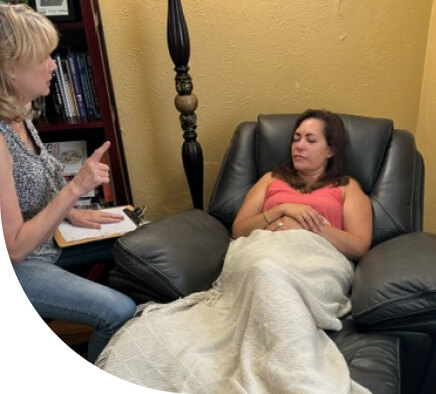
What an Actual Hypnosis Session Looks Like
Most people are surprised by how calm, conversational, and ordinary a real session is.
Step one — A real conversation
Your first session does not start with hypnosis. It starts with a real conversation. What pattern have you been carrying? When did it start to feel like a problem? What have you already tried? What does life look like on the other side of it? The work that happens in the chair is shaped directly by what you share at the start.
Step two — Settling the body
After the conversation, you get comfortable. Eyes closed if that feels right, though some people prefer to keep them open at first. You are guided to slow your breath and let the body sink into the chair. The voice you hear is calm, warm, and easy to follow. There is no test to pass to “ enter into hypnosis. You don’t have to clear your mind. You don’t have to feel anything specific.
Step three — The actual subconscious work
This is the part most people are curious about, and it’s also the part that’s the least dramatic. First you will be guided into a calmer state which varies from person to person. For instance some people feel very calm and others just slightly. From this calmer state, your hypnotist guides your attention through specific suggestions, imagery, or shifts — always tailored to the pattern you’re working on. You stay aware. You hear everything. You can stop, ask questions, or simply choose not to engage with a suggestion at any time.
Step four — Coming back and talking about it
At the end, you are guided back to full alert awareness gently. Most clients describe a quiet calm, sometimes a kind of mental clarity, sometimes just a feeling of being deeply rested. You can drive. You can go back to work. You can pick up the kids. Then a short conversation about what came up — sometimes insights show up right there or during thr session, sometimes the shift quietly unfolds over the next few days.
The Questions Almost Everyone Asks
Is hypnosis real?
Yes — and the most useful place to start if you have doubts is a real skeptic’s honest experience.
Does it work on everyone?
The honest answer and the science behind hypnotic responsiveness is laid out clearly here: Does hypnosis work on everyone?.
Can I hypnotize myself?
Yes — and there is a step-by-step way to think about it: Can I Hypnotize Myself? Understanding How Self-Hypnosis Really Works
Do you use recordings between sessions?
No. Here is exactly why, and why you don’t need them for real change: Why Family First Hypnosis doesn’t use recordings.
How many sessions will I need?
It depends on the pattern. Lasting work usually happens over a small series of sessions tailored to your specific goal, not a single dramatic one. Your hypnotist will be straightforward with you about what is realistic, what to expect, and when. The goal is never to keep you in sessions forever — it is to help you build the inner pattern that finally holds without needing the chair.
Do you work with people outside Plano?
Yes. The in-person practice is in Plano, Texas, and clients drive in from Frisco, McKinney, Allen, Richardson, Carrollton, The Colony, Garland, and across the wider Dallas–Fort Worth metroplex. One-on-one virtual sessions over Zoom and phone are also available — which means clients from anywhere can work with Celeste from their living room.
The Questions Almost Everyone Asks
Is hypnosis real?
Yes — and the most useful place to start if you have doubts is a real skeptic’s honest experience.
Does it work on everyone?
The honest answer and the science behind hypnotic responsiveness is laid out clearly here: Does hypnosis work on everyone?.
Can I hypnotize myself?
Yes — and there is a step-by-step way to think about it: Can I Hypnotize Myself? Understanding How Self-Hypnosis Really Works
Do you use recordings between sessions?
No. Here is exactly why, and why you don’t need them for real change: Why Family First Hypnosis doesn’t use recordings.
How many sessions will I need?
It depends on the pattern. Lasting work usually happens over a small series of sessions tailored to your specific goal, not a single dramatic one. Your hypnotist will be straightforward with you about what is realistic, what to expect, and when. The goal is never to keep you in sessions forever — it is to help you build the inner pattern that finally holds without needing the chair.
Do you work with people outside Plano?
Yes. The in-person practice is in Plano, Texas, and clients drive in from Frisco, McKinney, Allen, Richardson, Carrollton, The Colony, Garland, and across the wider Dallas–Fort Worth metroplex. One-on-one virtual sessions over Zoom and phone are also available — which means clients from anywhere can work with Celeste from their living room.
Why Family First Hypnosis
Celeste Hackett is a Board-Certified Consulting Hypnotist with more than two decades of experience, dual board certifications, contributions to the Journal of Hypnotism, and multiple awards in the field. Her practice has helped clients across North Texas through stop-smoking work, weight loss, anxiety, sleep struggles, relationships, sports performance, grief, anger, success blocks, and everything in between. Read more about Celeste on the About page, or read the 20-year story of how this practice came to be.
The Quietest, Most Honest Place to Start
If something has been quietly running your life longer than you’d like — a habit, a fear, a stuck place, a relationship pattern, a sleep problem, a weight pattern, a performance ceiling, a heaviness you’ve carried for a long time — hypnosis is worth a real conversation. The simplest, lowest-pressure place to start is the same place most clients began: schedule a free 30-minute Discovery Call with Celeste. You can ask anything still on your mind and see whether this work is the right fit for you.