



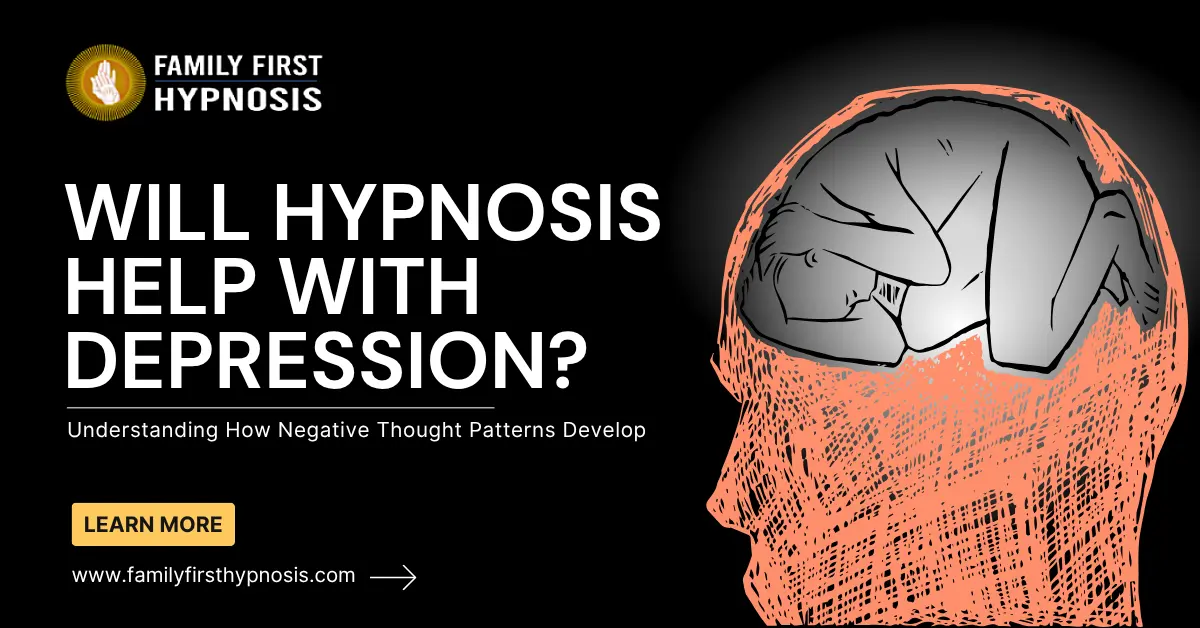
Depression often feels like being trapped in a loop. You find yourself caught in negative thought patterns that seem to play on repeat, influencing your mood, your energy, and your perspective on the future. Many people struggling with these persistent loops find themselves asking: “will hypnosis help with depression – something that hypnosis actually see a feeling of hopelessness?”
Often, people are not just looking for temporary motivation. They are trying to understand why certain emotional patterns feel so difficult to break. Negative thinking patterns rarely appear overnight. They usually develop gradually through repeated experiences, emotional conditioning, stress, and subconscious learning over time.
If you could trace things back you would find that first you were trying to resolve a primary emotion such as fear often called anxiety, or irritation often called anger, or loneliness. Then, when you could not do that you felt frustrated. The secondary emotion. If you stay in frustration long enough a feeling of hopelessness follows. You can be stuck here a long time until the underlying feelings resolved. Many hypnosis clients feel hopeful even after the first session.
At Family First Hypnosis, we approach these emotions and experiences that led up to your feelings carefully and ethically. Hypnosis does not diagnose or treat medical or mental health conditions, but it may help people better understand subconscious patterns that contribute to emotional heaviness, stress, and repetitive negative thinking.
How Negative Thought Patterns Begin
The subconscious mind constantly absorbs information from experiences, environments, relationships, and emotional events. Over time, repeated experiences can shape internal beliefs such as:
- “I’m not good enough”
- “Things never work out for me”
- “I always fail”
- “I’m stuck this way”
- “It’s hopeless”
These thoughts often begin as emotional reactions to difficult experiences, criticism, fear, stress, or disappointment. Eventually, repeated thoughts can become automatic subconscious patterns.
The Brain Learns Through Repetition
The mind is designed to recognize patterns. When certain emotional responses or thoughts are repeated often enough, the subconscious mind starts treating them as familiar and automatic, meaning they will come to your consciousness and you’ll be aware that you feel bad again and again. This is why people sometimes feel trapped in cycles such as overthinking, self-criticism, emotional heaviness, worry, fear, and hopeless internal dialogue. These responses may continue even when a person consciously wants to think differently.
Will Hypnosis Help With Depression-Related Thought Patterns?
Yes. Professional Hypnosis works by helping people access subconscious patterns in a calm and supportive state of awareness. Rather than forcing positive thinking, hypnosis sessions may help individuals:
- Become aware of subconscious emotional responses
- Identify repeating internal narratives
- Understand exactly where certain patterns began
- Develop healthier emotional associations
- Create more supportive subconscious responses over time
- Update old patterns and feelings through subconscious realization
Many people discover that emotional patterns are connected to experiences and beliefs formed long before they fully understood them consciously. Understanding them in a better way updates the subconscious so that what is then triggered is no longer the negativity but much more positive feelings.
[Image demonstrating the link between past conditioning and current subconscious thought patterns]
Why Willpower Alone Often Feels Exhausting
People frequently try to fight negative thinking using willpower, temporary motivation, positive affirmations, or the outright suppression of emotions. But subconscious patterns are often stronger than surface-level effort alone. That’s because the subconscious mind operates automatically. And that is why subconscious patterns need to be updated.
Trying to “force” different thoughts without addressing the deeper emotional pattern can sometimes feel frustrating or emotionally draining. This is one reason why subconscious work feels meaningful for people seeking emotional support. And also why it’s so very often helps when everything else has failed.
The Role of Emotional Conditioning
Negative thought patterns are often reinforced by emotional conditioning. For example, repeated criticism may create self-doubt, while stressful environments can reinforce fear-based thinking. Similarly, emotional pain can create protective subconscious habits, and long-term overwhelm may eventually normalize emotional exhaustion. Over time, these responses become familiar patterns the nervous system automatically repeats. Hypnosis may help people gently interrupt these cycles by bringing subconscious awareness of peace, confidence and strength to the surface instead.
Understanding Emotional Burnout
Many individuals asking “will hypnosis help with depression” are also experiencing deep emotional burnout. Emotional burnout may include:
- Feeling mentally exhausted
- Experiencing emotional numbness
- Difficulty feeling motivated
- Feeling completely disconnected from yourself
- Living with chronic stress and overwhelm
When the nervous system remains under stress for long periods, negative thought patterns can become even more deeply reinforced. This is why emotional support and subconscious updates often requires more than surface-level encouragement.
Hypnosis and Subconscious Awareness
At Family First Hypnosis, hypnosis is approached as a supportive process that helps clients better understand and change subconscious behaviors and emotional responses. Sessions help individuals feel calmer and helps them emotionally, recognize unhealthy internal narratives, build healthier thought patterns, improve emotional regulation, and develop greater self-awareness. The process is collaborative, gentle, and focused on long-term emotional growth rather than quick fixes. And yet is much faster and deeper than therapy.
When Additional Support Is Important
Family First Hypnosis encourages anyone experiencing severe emotional distress or mental health concerns to seek support from licensed healthcare or mental health professionals. Hypnosis is not a replacement for medical or psychological treatment. Instead, it serves as a complementary approach that supports emotional wellness, subconscious awareness and change, along with personal growth.
What Negative Thought Patterns Really Need
Negative thought patterns rarely change through self-criticism, pressure or even conscious surface level awareness. More often, meaningful change begins through subconscious awareness, understanding, emotional change, supportive subconscious shifts, and consistent emotional regulation. The goal is not perfection. The goal is learning updating the subconscious mind in a healthier and compassionate way so that changes happen automatically.
If you’ve been wondering, “will hypnosis help with depression?” It may help to begin by understanding how negative thought patterns develop in the first place. Many emotional struggles are connected to subconscious patterns formed through repetition, stress, emotional conditioning, and life experiences over time. These patterns were not coming from modern day awareness, but all stuck thinking and beliefs that do not fit you anymore.
If you are ready to resolve the patterns that have been holding you back, we are here to guide you.
[Click here to schedule your FREE Discovery Call with Celeste.]