


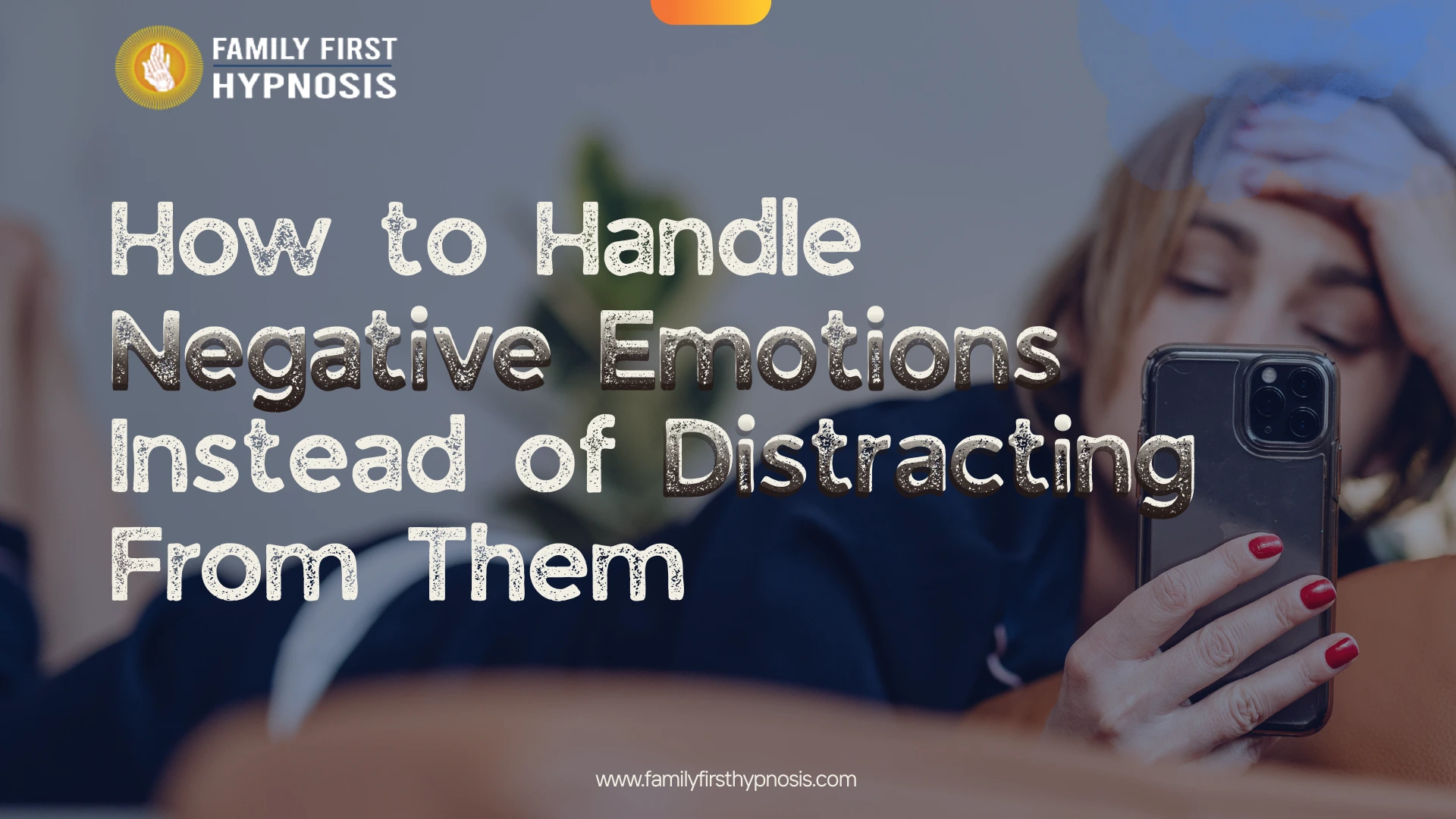
Many people wonder how to handle negative emotions when uncomfortable feelings show up. Stress, frustration, sadness, and anxiety are all natural emotional responses, yet most people were never taught healthy ways to process them.
Instead, many of us learned something else: distraction.
Understanding how the subconscious mind processes emotions can help explain why certain feelings keep returning — even after we try to ignore them.
Watch Celeste Explain Why You Can’t Hide From Your Feelings
In the video below, professional hypnotist, Celeste Hackett explains why these distractions never actually make the feeling go away—and what it looks like to finally move toward true emotional resolution.
Why People Distract Themselves From Negative Emotions
When people feel uncomfortable emotions, their first instinct is often to avoid them.
- Digital Devices: Endless social media scrolling.
- Physical Habits: Food, tobacco, or nail-biting.
- Substances: That evening glass of wine to “unwind.”
- Busyness: Staying constantly active to avoid the quiet.
While these shift your attention away from the discomfort, distraction is not the same as resolution. These distractions shift attention away from the feeling for a while, which can make someone feel better temporarily.
However, distraction is not the same as emotional resolution.
What Happens When the Distraction Is Removed
As a consulting hypnotist, Celeste notes that when a distraction disappears, the emotion that was being avoided can suddenly become more noticeable.
For example:
- A child may become emotional when a device is taken away.
- Someone who stops drinking alcohol after using it to relax may feel irritable for a short time.
- A person who quits smoking or tobacco may feel unsettled while the habit fades.
Part of this reaction comes from the habit itself. When a routine behavior is interrupted, the mind takes time to adjust.
But once the habit fades, what remains is the original emotional experience that had been pushed aside.
This moment can feel uncomfortable for people who never learned how to handle negative emotions without distractions.
Why Distractions Don’t Resolve Emotional Stress
Distractions work by redirecting attention.
When someone scrolls on a phone, eats something, or turns to a familiar habit, their focus moves away from the uncomfortable feeling. This creates a sense of relief.
But the emotion itself doesn’t necessarily disappear. Instead, it often moves into the subconscious mind.
Because the feeling hasn’t truly been processed, it may resurface again later. This can create repeated patterns where someone continues turning to the same distraction whenever stress or discomfort appears.
Over time, the cycle may look like this:
- A stressful feeling appears.
- The person distracts themselves.
- The feeling fades temporarily.
- The same emotion returns later.
Guided hypnosis involves breaking this cycle.
The Difference Between Avoiding Feelings and Processing Them
Many people grow up learning to ignore or suppress their feelings rather than understand them.
Common messages people receive include:
- “Don’t cry.”
- “Just ignore it.”
- “Stay busy and you’ll forget about it.”
While these approaches may seem helpful at the moment, they do not teach people how to process emotions in a healthy way.
When emotions are acknowledged and understood, they often lose their intensity naturally. But when they are repeatedly pushed away, they can remain active beneath the surface.
This is why people may feel the same stress, frustration, or anxiety again and again.
Why Emotional Awareness Is Important
One of the first steps in learning how to handle negative emotions is simply becoming aware of them.
Emotions are signals from the mind and body. They reflect something we are experiencing or perceiving in the moment.
When people allow themselves to notice a feeling without immediately distracting from it, they create the opportunity to process it.
Over time, this awareness can lead to healthier emotional responses and less reliance on automatic habits.
How the Subconscious Mind Influences Emotional Patterns
The subconscious mind plays a powerful role in emotional responses.
It stores past experiences, learned reactions, and automatic habits. When a situation reminds the mind of previous stress or discomfort, the subconscious may trigger familiar emotional responses.
If someone has learned to escape those emotions through distractions, that response can become automatic.
Working with the subconscious mind can help update these patterns so that emotions can be handled in a calmer, more balanced way.
How Hypnosis Supports Emotional Regulation
Hypnosis is often used as a supportive approach to help people develop healthier emotional responses, it is like a subconscious coaching for emotional awareness.
At Family First Hypnosis, hypnosis sessions focus on helping clients become more aware of their emotional patterns and encouraging a calmer relationship with their feelings.
Instead of suppressing or avoiding emotions, guided hypnosis can help individuals:
- Reduce subconscious tension
- Respond more calmly to stress
- Neutralize emotional triggers
- Build healthier coping patterns
Many clients report feeling more relaxed and emotionally balanced as they learn how to handle negative emotions in a more natural way.
When Habits Are Really About Emotions
Many everyday habits are closely connected to emotional regulation.
For example:
- Emotional eating
- Drinking to relax
- Smoking or vaping
- Nail biting
- Excessive device use
In many cases, these habits develop as ways to soothe uncomfortable feelings.
Understanding the emotional layer behind a habit can make it easier to change the behavior without relying on willpower alone.
Learning Healthier Ways to Handle Emotions
Learning how to handle negative emotions is a skill that many people were never formally taught.
But it can be developed. With the right guidance and awareness, people can learn to recognize emotions, process them calmly, and move forward without needing to rely on distractions.
This often leads to greater emotional balance, improved relationships, and a stronger sense of inner control.
Support From Family First Hypnosis
At Family First Hypnosis, Celeste works with clients who want to better understand their emotional patterns and develop healthier responses to stress.
Sessions are designed to help the subconscious mind settle, allowing emotions to be processed more naturally rather than avoided.
Virtual sessions are available for clients who prefer to work from home.
If you’ve been searching for better ways to manage stress or wondering how to handle negative emotions without relying on distractions, support is available.
You’re welcome to reach out to Family First Hypnosis to ask questions and explore whether hypnosis sessions may be a helpful step toward greater emotional balance.
Schedule Your Free 30-Minute Phone Consultation with Celeste Today!